
Yongjian Machinery3 min de leitura
How to specify a stainless steel tube mill (a buyer's checklist)
The six decisions that determine whether a tube mill fits your business — and the specification mistakes that cost buyers the most money.
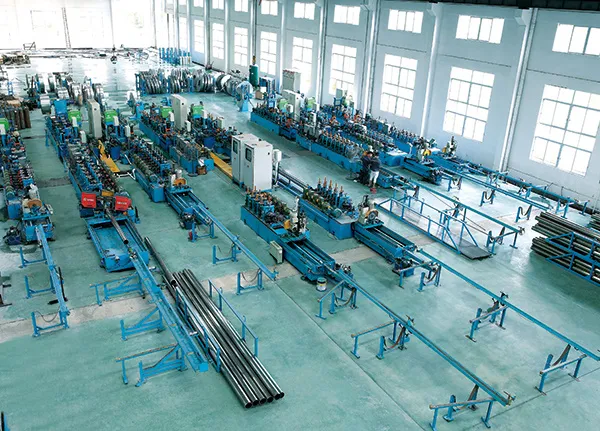
Most tube mill enquiries we receive start with a diameter range and a budget. Those are the two least useful pieces of information for working out whether a machine fits the business. Here is what actually decides it.
1. Start from the heaviest wall, not the largest diameter
Almost every buyer specifies by diameter. But the forming loads on a mill scale far more steeply with wall thickness than with diameter. A Ø60 mm tube at 1.0 mm wall and the same tube at 3.0 mm wall are completely different jobs for the forming section, the drive and the welder.
If you specify to your largest diameter at your thinnest wall, you will get a machine that produces that tube beautifully and then struggles the first time you win heavier-wall work. Specify the worst case you realistically intend to run — the combination of large diameter and heavy wall.
2. Work out whether changeover or line speed is your real constraint
This is the single biggest specification error we see.
Buyers compare line speeds across quotations because it is the easiest number to compare. But for a shop running many sizes in small batches — which describes most decorative and job-shop tube producers — the mill spends more hours being changed over than it does running at top speed.
Do the arithmetic for your own order book. If your average batch is two hours of running and your changeover is ninety minutes, then halving changeover time increases output far more than a 30% faster line ever will. In that case, quick-change roll cassettes and stored setup recipes are worth more than drive power.
If you are running long batches of a few sizes, the opposite applies and line speed genuinely is the number to optimise.
3. Decide the finish before you choose the polishing line
Polishing head count should be derived from the finish grade you sell. A satin finish needs far fewer heads than a mirror finish.
Buying more heads than your product needs is wasted capital. Buying fewer and running tube through twice costs more in handling and labour than the extra heads would have. Neither error is visible until you are in production.
4. Treat tooling as part of the machine decision
Roll tooling decides tube quality. The mill supplies force and motion; the roll profile determines shape, surface and seam quality.
Ask any prospective supplier:
- Do you machine tooling in-house, or subcontract it?
- Do you retain profile drawings for repeat orders?
- What is the lead time on a replacement roll set?
- Can you supply tooling for mills you did not build?
A supplier who subcontracts tooling and does not retain drawings will give you a different roll profile on your second order than your first. If you are holding a dimensional specification, that is a real problem.
5. Settle compliance requirements before build, not after
If you are importing into the EU or UK, CE marking and machinery directive conformity are configuration and documentation decisions that have to be made before manufacturing starts. The same applies to electrical standards in markets with specific requirements.
Retrofitting compliance to a finished machine is expensive and sometimes impossible. Raise it at enquiry and get the answer in writing.
6. Plan the building in parallel with the machine
For most buyers, getting the building ready takes longer than manufacturing the machine. Foundations, power capacity, cooling water, extraction and material flow all need designing.
Ask your supplier for foundation drawings, electrical load and water consumption figures at quotation stage rather than after you have paid a deposit. Any supplier who cannot produce these quickly has probably not thought carefully about installation.
The short version
| Decision | Specify from |
|---|---|
| Machine class | Heaviest wall at largest diameter |
| Speed vs changeover | Your actual batch sizes |
| Polishing heads | The finish grade you sell |
| Tooling | In-house machining and drawing retention |
| Compliance | Destination market, before build |
| Site readiness | Foundation and utility data, at quotation |
If you would like help working through this for a specific tube range, send us your sizes, wall thickness, material grade and target output and we will come back with a configuration and the reasoning behind it.
- Buying guide
- Tube mills
- Specification