
Yongjian Machinery3 мин чтения
Why welded stainless pipe corrodes along the seam — and what annealing does about it
Welding locally destroys the corrosion resistance of stainless steel. The metallurgy, and why inline solution annealing is not optional for fluid service.
A recurring complaint from buyers new to welded stainless pipe: the pipe corrodes in service, and it corrodes in a line running down its length. The body of the pipe is fine. The seam is not.
This is not a welding defect. It is predictable metallurgy, and it has a standard solution.
What welding does to stainless steel
Stainless steel resists corrosion because chromium is dissolved in the steel matrix, where it forms a self-repairing passive oxide layer at the surface. The key word is dissolved — chromium has to be in solution to do this.
When you weld, the zone either side of the seam passes through roughly 450–850 °C. In that range, chromium combines with carbon and precipitates out as chromium carbides at the grain boundaries. The carbides themselves are not the problem. The problem is that forming them pulls chromium out of the surrounding material, leaving a chromium-depleted band along each grain boundary.
That depleted band no longer has enough chromium to passivate. The result is a pipe that is corrosion resistant everywhere except along two narrow strips either side of the weld.
This is called sensitisation, and in service it shows up as intergranular corrosion — attack that follows the grain boundaries rather than eating the surface evenly. It is particularly aggressive in chloride environments, which includes most food processing, water treatment and marine applications.
What solution annealing does
Solution annealing takes the material back above about 1050 °C. At that temperature the chromium carbides redissolve and the chromium goes back into solution.
The critical part is what happens next. The material has to be cooled quickly through the sensitisation range, so the carbides do not simply re-form on the way down. Heat it and cool it slowly and you have achieved nothing.
Done correctly, the result is uniform corrosion resistance across the weld zone and the parent material, plus recovered ductility — which matters if the pipe will be bent or formed downstream.
Why inline rather than batch
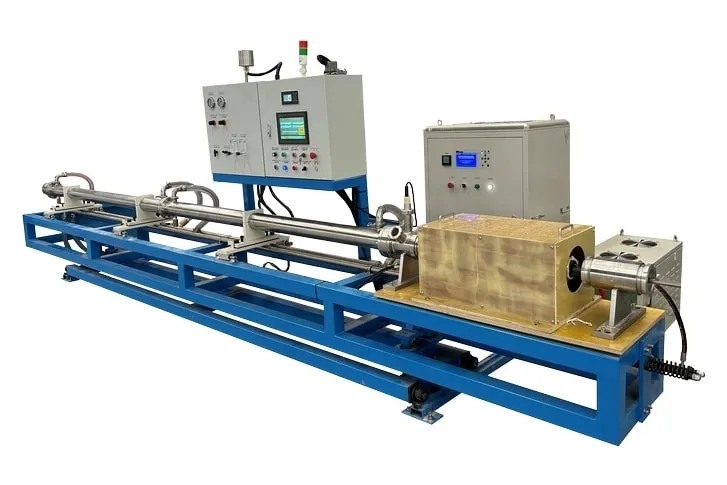
Solution annealing can be done as a batch operation in a furnace after production. Inline annealing, where the pipe passes through an induction coil immediately after welding as part of the mill line, has three practical advantages:
- No second handling operation. Batch annealing means moving finished pipe to a furnace, processing it, and moving it back. That is labour, floor space and damage risk.
- Controlled, repeatable heat input. With closed-loop pyrometer control, every metre of pipe sees the same thermal cycle. Batch furnace loading is far less uniform.
- Lower energy per tonne. You are heating a moving pipe through a coil, not heating a furnace and its contents from cold.
Bright annealing and why it removes the pickling line
Heating stainless in air forms scale, which then has to be removed by acid pickling. Running the annealing under a protective hydrogen/nitrogen atmosphere prevents the scale forming at all. The pipe exits bright.
For most buyers the finish is not the main benefit. The main benefit is not having to operate an acid pickling line — the chemistry, the handling, the safety provision, and the disposal of spent acid. In a growing number of jurisdictions the disposal permitting alone is a serious operational burden.
When you need it, and when you do not
You need solution annealing if:
- The pipe carries fluid, especially food, beverage, pharmaceutical or chemical product
- The service environment contains chlorides
- The pipe will be bent or formed after production
- Your customer specifies it, or specifies a corrosion test the pipe must pass
You probably do not need it if the pipe is purely decorative or structural, stays dry, and is not formed after manufacture. Furniture tube and railing generally do not justify it.
The mistake is assuming it is a premium upgrade. For fluid service it is not optional — it is what makes the pipe fit for the application.
- Metallurgy
- Annealing
- Quality