
Service & support
What happens after the machine lands
The difference between a working line and an expensive shed ornament is usually commissioning and training. Here is exactly what we provide, and what we expect from you.
Six things we do for you
Pre-purchase engineering
We size the line to the tube you intend to sell, and tell you what it will realistically produce at each wall thickness — not just the headline figure. If your target output does not match your budget, you will hear that before you order, not after.
Installation & commissioning
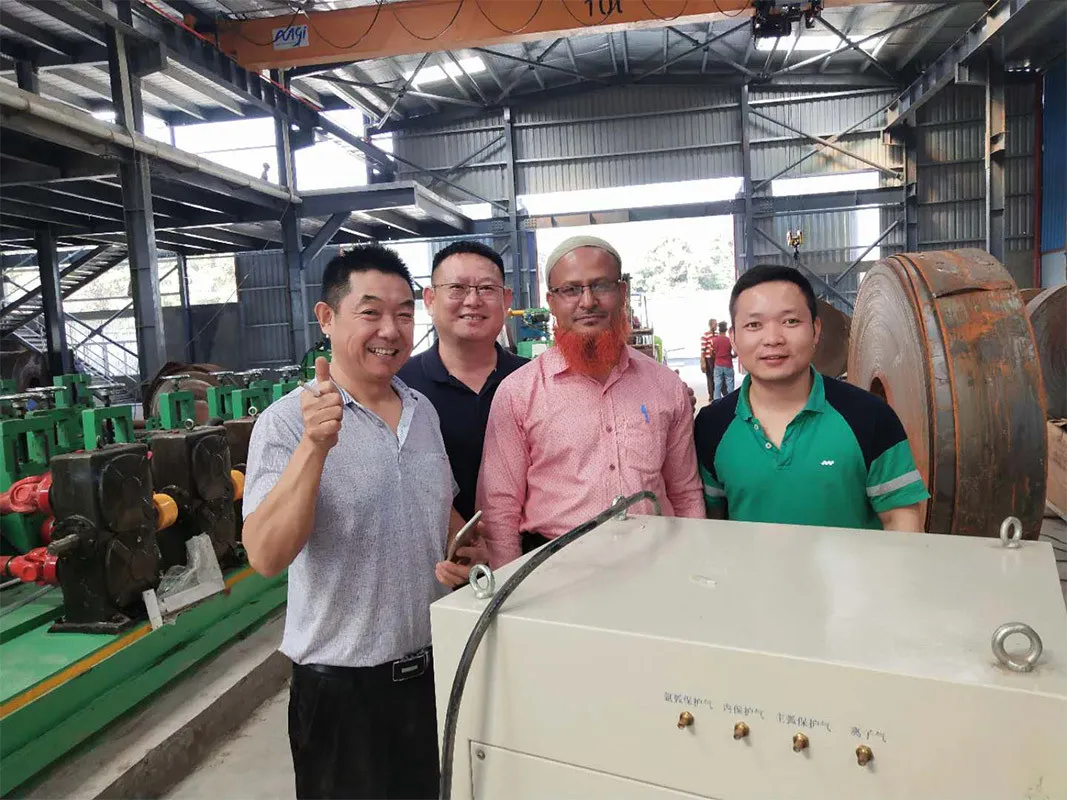
Our engineers travel to your site, install the line, align it, and run it to rated output using your material. Buyer covers travel, visa and accommodation; the engineering time is part of the supply.
Operator training
We train your team on setup, roll changeover, weld parameter adjustment and routine maintenance before we leave. A mill nobody on site can change over is a mill running one size forever.
Tooling & spare parts
Because we machine rolls in-house, new sizes and replacement tooling come from the people who built your mill. Send the section you need and we will quote the roll set.
Remote diagnosis
Video call with the engineer who knows your line. Most electrical and setup faults are resolved this way, which beats waiting on a flight.
Line upgrades
Adding solution annealing, inner weld levelling or polishing to an existing mill — including mills we did not build. Tell us what you have and what you want to add.
Questions buyers actually ask
Commercial and technical answers in plain language. If yours is not here, ask us directly — we would rather answer it than have you guess.
Buying
What information do you need to give me an accurate quotation?
Five things let us quote properly rather than send a generic price list:
- Tube size range — outside diameter and whether you need round, square, rectangular or special-shaped sections.
- Wall thickness range — specifically the heaviest wall you intend to run. This drives the forming loads and the motor sizing more than diameter does.
- Material grade — 201, 304, 316L, 430 or carbon steel. Grade changes forming behaviour and weld parameters.
- Target output — tonnes per month or metres per hour, and how many shifts you plan to run.
- Power supply — your voltage, frequency and phase. We configure to your local supply.
If you are not sure about some of these, send what you do know. Most buyers do not have all five settled at first enquiry, and working out the right configuration is part of what we do.
Can the machine be customised to my requirements?
Yes — most of our lines are configured to order rather than sold from stock. Stand count, drive power, welder capacity, cutting method, control system and the roll tooling are all specified around your tube range and output.
What we will not do is quote a configuration we do not think will work. If you ask for a size range that the machine class cannot hold to the tolerance you need, we will say so and quote the class that can.
What are your payment terms?
We confirm this in writing with every quotation rather than publish a figure that may not apply to your order. Ask us and you will get the exact terms for your project — usually the same day.
What is the lead time from order to shipment?
We confirm this in writing with every quotation rather than publish a figure that may not apply to your order. Ask us and you will get the exact terms for your project — usually the same day.
Can I visit the factory before ordering?
Yes, and we recommend it. Our facility is in Gaoming District, Foshan, about 90 minutes from Guangzhou Baiyun International Airport (CAN) and roughly two hours from Hong Kong.
A visit lets you see machines in build, inspect our CNC machining and tooling production, and meet the engineers who would commission your line. We can issue an invitation letter to support your visa application.
If travel is not practical, we can run a live video walkthrough of a machine in production instead.
Technical
Why do some manufacturers get higher output from the same machine?
This is the question we get asked most, and the answer is almost never the machine itself.
Where identical mills and identical tooling produce very different output, the difference is usually one of these:
- Roll setup discipline. A mill set up correctly for a size, with settings recorded and recalled, runs faster and scraps less than one an operator rebuilds from memory each changeover.
- Tooling condition. Worn rolls force operators to slow the line to hold dimensions. Tooling is treated as a consumable to replace on condition, not to run until it fails.
- Strip quality and consistency. Variation in strip width, thickness or edge condition shows up immediately as weld and dimensional problems. Cheap strip is often the most expensive input in the line.
- Weld parameter control. Operators who are not confident in the weld settings run below the machine’s capability as a safety margin. That margin is pure lost output.
- Changeover time. For shops running many sizes in small batches, changeover — not line speed — is the real constraint on monthly output.
Our commissioning engineers work through all five with your operators during installation. The machine is the easy part.
What tube sizes can your equipment produce?
Across the full range of our equipment we cover Ø5 to Ø630 mm, in round, square, rectangular and special-shaped sections.
No single machine covers that whole range. It is divided across machine classes — small decorative mills at the bottom end, large-diameter industrial lines at the top. Each individual line is specified for a working range, and the roll tooling sets the sizes within it.
Tell us your sizes and we will tell you which class fits — and whether you need one line or two.
Which materials can your machines run?
Standard configurations handle stainless grades 201, 304, 316L, 409, 430 and 439. Carbon steel is available on the industrial and large-diameter lines.
Duplex and higher-alloy grades are possible but significantly change forming loads and weld parameters, so they must be specified at enquiry stage rather than added later. A machine configured for 304 will not simply run duplex.
Do you supply roll tooling for machines you did not build?
Yes. We machine roll tooling in-house on our own CNC centres and supply sets for third-party mills as well as our own.
Send us the stand dimensions, shaft diameter and your tube specification — or send an existing roll for us to work from — and we will quote. We retain profile drawings, so repeat orders match the original rather than being re-interpreted from a worn sample.
Shipping & installation
How is the equipment packed and shipped?
We provide the transport information for your machine, take responsibility for loading it, and handle the transport formalities on your behalf. Throughout the journey we keep track of the shipment’s safety and its logistics information.
Do you install the machine at my factory?
Yes. Our after-sales service team of five is responsible for installing, commissioning and servicing the machines we sell, in China and abroad. Every one of them has more than ten years’ experience in pipe making and machine setting, so problems are dealt with promptly and your production keeps running normally.
We also provide technical documents and technical support for installing, maintaining and operating the machine.
Can you help plan the factory layout before the machine arrives?
Yes, and this is worth starting early. For most buyers, getting the building ready takes longer than manufacturing the machine.
We provide:
- Complete welded pipe project technical scheme support
- Plant layout and foundation requirements
- Electrical load and water consumption figures
- Guidance on material flow and finished-stock handling
Buyers who leave this until the machine is on the water usually end up with the line waiting in crates while the building catches up.
After-sales
What does your after-sales service actually cover?
Our standard after-sales scope is:
- Welded pipe process technology provided free — the know-how, not just the hardware.
- Operator training for your staff, during commissioning and afterwards.
- Personnel sourcing assistance — we can help you find experienced machine and polishing operators if you are staffing a new line.
- Plant design support — layout, foundation, electrical load and water consumption.
- On-site installation and commissioning, with our engineers staying until the line produces pipe to specification.
How do I get spare parts after installation?
We confirm this in writing with every quotation rather than publish a figure that may not apply to your order. Ask us and you will get the exact terms for your project — usually the same day.
What warranty do you provide?
We provide a one-year product warranty, within the scope of the equipment warranty. Damage caused by misuse is not covered, and neither are wearing parts. After the warranty period we continue to provide service on a paid basis.
We also provide technical documents and technical support for installing, maintaining and operating the machine.
Question not answered here?
Ask Richard directly. Technical questions reach an engineer, not a scripted reply.
Send us your tube specification
Diameter range, wall thickness, material grade and target output. We will reply with a configuration and the reasoning behind it — not a generic price list.
Reply within one business dayEngineer, not a call centre